
More Than a Massage.
Clinical Massage Therapy is a focused, health-oriented form of bodywork designed to address specific physical issues. Unlike a traditional spa massage meant for stress relief, this medical approach aims to treat chronic pain, heal injuries, and fix structural alignment problems.
Clinical Massage Therapy Helps With…
Pain & Tension
Target persistent areas of muscular tension and discomfort.
Injury Recovery
Support your body's recovery following injury or periods of physical strain.
Mobility
Address restrictions that may be limiting how you move.
Performance & Recovery
Help your body recover and prepare for the demands of training.
-
Resolves stubborn scar tissue and chronic tension patterns from past injuries.
-
Eliminates fascial friction so your joints can reach full, unrestricted power and extension.
-
Restores optimal tissue resting tone to prevent future compensatory strains and overuse injuries.
-
Flushes deep-tissue stagnation to shorten recovery windows between demanding training blocks.
Performance & Recovery Benefits
Our Multimodal Approach
I am proficient in administrating several treatment modalities:
-
Direct, sustained ischemic compression breaks the neuromuscular pain cycle, releasing chronically contracted fibers and restoring optimal resting length.
-
Using specialized ergonomic tools, we locate and break down restrictive scar tissue, adhesions, and fascial cross-links to stimulate a healthy, localized healing response.
-
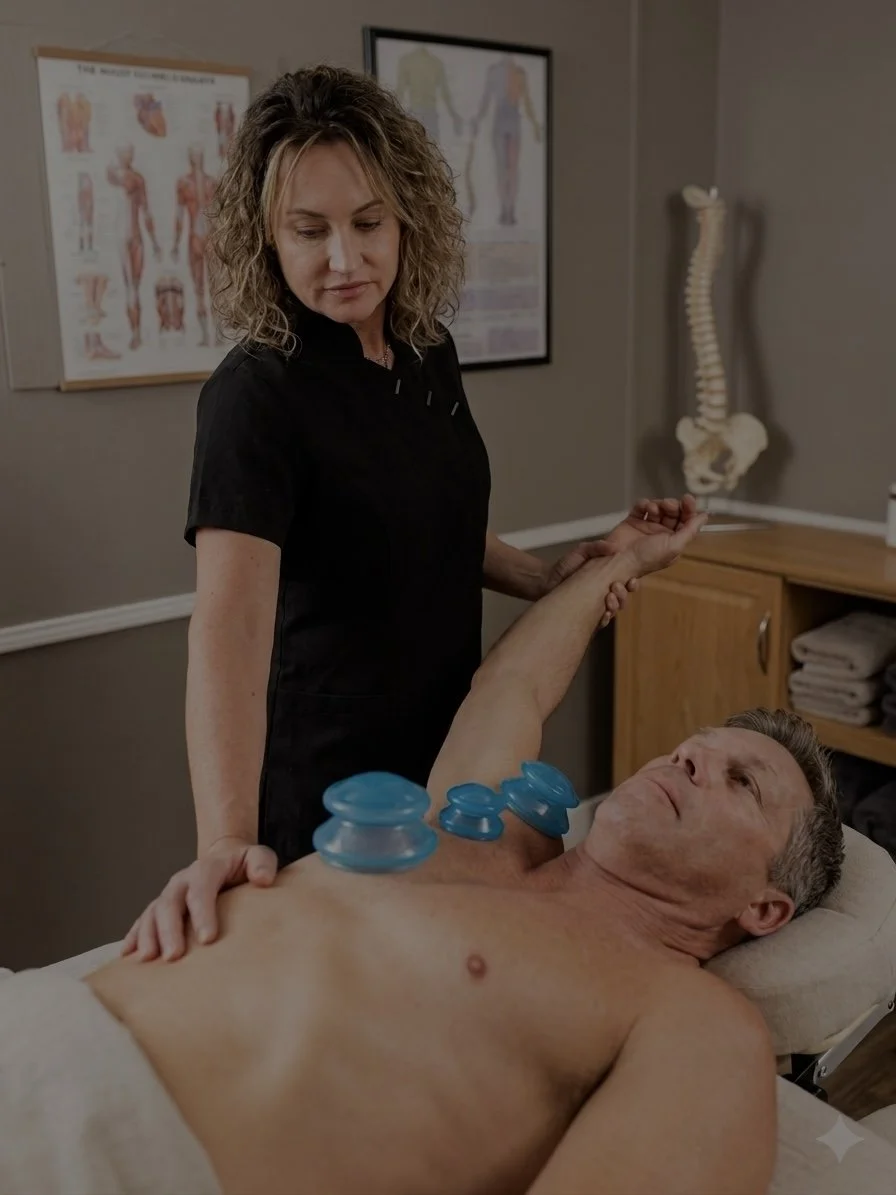
While manual pressure compresses tissue, negative-pressure cupping lifts and separates fascial layers. This decompresses tight structures, dramatically increases local microcirculation, and accelerates metabolic clearance.
-
Integrating passive, dynamic, and Proprioceptive Neuromuscular Facilitation (PNF) stretching to immediately reinforce newly gained range of motion and retrain healthy movement patterns.
Special Conditions
I specialize in treating a wide range of conditions, including:
Muscle Tension and Pain
Scar Tissue and Fascial Adhesions
Joint pain including Neck, Shoulders, Elbow, Back, knees, and Ankles
Shoulder Impingement
Chronic and Acute Pain
TMJ
Headaches
Sciatica
Sports Injuries
Plantar Fasciitis
Rotator Cuff Syndrome
Medial or Lateral Epicondylitis
Carpal Tunnel
Pelvic Floor Dysfunction
What to Expect?
Your session is an active, movement-focused collaboration. Drawing on background expertise in physical rehabilitation and exercise science, we evaluate your posture, joint range, and functional movement to pinpoint the exact soft-tissue structures driving your limitations.
During treatment, we selectively integrate trigger point work, cupping, IASTM, and stretching based on what your tissues need most. We work dynamically with your feedback and breath, ensuring every technique remains productive, targeted, and aligned with your recovery goals.
-
While traditional massage relies on downward compression to release tissue, Cupping Therapy utilizes negative pressure to pull tissue upward. By creating a precise vacuum, this modality lifts and separates stuck layers of skin, fascia, and muscle. This decompresses tight structures, creates space for restricted joints, and immediately stimulates a powerful healing response.
Rapid Cellular Flush: The vacuum suction draws stagnant, metabolic waste out of deep muscle tissue, flooding the area with fresh, nutrient-rich arterial blood to speed up recovery.
Fascial Release: Breaks up rigid adhesions between fascial layers, allowing your muscles to glide smoothly without internal friction.
Neurological Down-Regulation: Sedates the central nervous system, making it highly effective for releasing deep-seated chronic tension and reducing overall pain perception.
What to Expect: You will feel a deep pulling or warming sensation. The treatment frequently leaves temporary, circular discoloration (cupping marks). These are not bruises; they are a normal physiological response to cellular debris being drawn to the surface, and they typically fade within a few days.
-
Repetitive athletic strain, surgeries, and old injuries often leave behind dense, disorganized webs of scar tissue and fascial adhesions. Instrument-Assisted Soft Tissue Mobilization (IASTM) utilizes specialized, medical-grade ergonomic steel tools to precisely locate and treat these deep architectural restrictions in your soft tissue.
Micro-Vibration Detection: The rigid nature of the steel tools acts like a stethoscope for your muscles, allowing us to feel exactly where healthy tissue transitions into gritty, restricted scar tissue.
Targeted Adhesion Breakdown: Applies controlled, localized friction to gently break down cross-linked collagen fibers, smoothing out the muscle profile.
Triggering the Healing Cascade: Instigates a controlled micro-trauma in the restricted area, signaling your body to initiate a natural inflammatory response that replaces old scar tissue with healthy, linear fibers.
What to Expect: The specialized tool is swept across the skin over a therapeutic lubricant. You may feel a gritty sensation in restricted areas, accompanied by mild, temporary redness (petechiae) as blood flow rushes to the surface to begin the remodeling process.
-
Gaining passive flexibility is only half the battle; to prevent re-injury and optimize athletic performance, your nervous system must learn to control that new range of motion. Our targeted mobility work integrates advanced stretching protocols—specifically Proprioceptive Neuromuscular Facilitation (PNF)—to active-assist your body into safer, deeper, and more powerful functional movement.
The PNF Reset: Utilizing a "contract-relax" method, we guide your target muscle through a brief isometric contraction against resistance, followed by a voluntary relaxation. This triggers a neurological reflex that safely overrides your muscle's protective stretch reflex, allowing for immediate depth gains.
Neuromuscular Efficiency: Retrains your brain and muscles to communicate properly at their end-ranges of motion, turning passive flexibility into active, usable athletic power.
Joint Centration & Alignment: Rebalances pulling forces around major joint complexes (like the hips and shoulders) to eliminate compensatory movement strains.
What to Expect: This is an active, collaborative modality. You will be asked to actively push against gentle resistance and synchronize your movements with targeted breathwork, leaving your joints feeling uniquely light, stable, and unlocked.
Massage Pricing*
90 minutes is recommended for full body requests in order to effectively address specific areas of concern.
*We accept Workers’ Compensation claims for prescribed massage therapy.
*If you cannot find an appointment, please feel free to reach out.